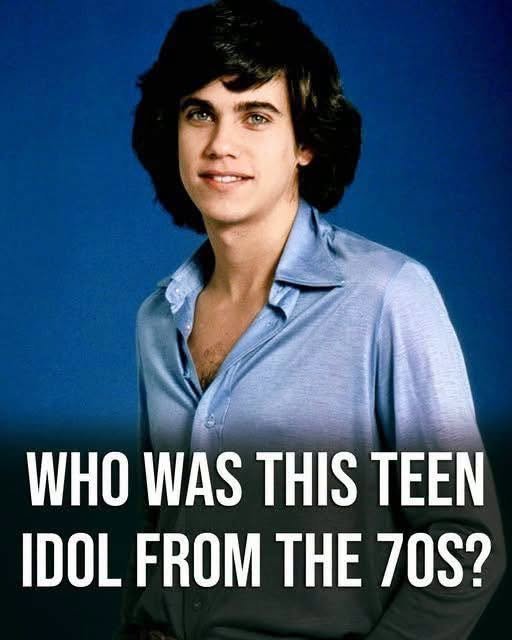
Who Was This Teen Idol From the ’70s? The Extraordinary Rise and Legacy of David Cassidy
For anyone who lived through the early 1970s, there are some faces that never completely disappear from memory.
One of those faces belonged to David Cassidy.
With his feathered hair, warm smile, youthful appearance, and instantly recognizable voice, Cassidy became one of the most famous young entertainers of his generation. He was not simply a television actor. He became a recording star, a concert sensation, a magazine favorite, and one of the defining teen idols of the 1970s.
For a few extraordinary years, it seemed as though his image was everywhere.
He was on television.
He was on record covers.
He was on lunch boxes, posters, magazines, and merchandise.
Young fans screamed when he appeared on stage.
Teen magazines competed for stories about him.
And his character, Keith Partridge, became one of the most recognizable fictional teenagers on American television.
Yet the story of David Cassidy is much more complicated than the smiling photograph that appeared on bedroom walls.
Behind the fame was an actor who wanted to be taken seriously.
Behind the teen idol was a young man trying to understand what had happened to his life.
And behind the enormous success was a career that would continue long after the screaming crowds had quieted down.
The Face Millions First Saw on Television
Cassidy’s breakthrough came in 1970 when he was cast as Keith Partridge on The Partridge Family.
The ABC sitcom followed a widowed mother and her children who formed a successful family pop group and traveled from place to place performing music.
Shirley Jones played the mother, Shirley Partridge.
Cassidy played her eldest son, Keith.
There was an unusual connection between the two performers: Jones was Cassidy’s stepmother in real life.
The show was intended as a television vehicle built around Jones, but Cassidy quickly emerged as its most prominent young star.
The series ran from 1970 to 1974 and became an enormous popular success. The show combined comedy, family entertainment, music, colorful costumes, and a young cast that television audiences quickly embraced.
But what happened to Cassidy off screen was even bigger.
He became a genuine cultural phenomenon.
“I Think I Love You” Changes Everything
The defining musical moment arrived with “I Think I Love You.”
The song was performed by the fictional Partridge Family, but Cassidy was the principal young male voice audiences heard.
Released in 1970, it quickly became a massive hit.
According to Billboard’s historical record, “I Think I Love You” reached No. 1 on the Hot 100 for three weeks beginning in November 1970.
That success transformed Cassidy’s position almost overnight.
He was no longer simply the handsome teenager from a television sitcom.
He was a genuine pop star.
The show’s fictional premise had unexpectedly produced a real-world music phenomenon.
Cassidy became the face of the group in the minds of millions of fans, and the entertainment industry quickly recognized that his appeal extended far beyond the television screen.
His official biography describes the scale of the phenomenon that followed, including enormous record sales, sold-out concert performances, and merchandising on a global scale.
The Birth of “Cassidymania”
Today, celebrity fandom can be difficult to measure because social media produces numbers almost instantly.
In the 1970s, fandom looked different.
It meant fan clubs.
Teen magazines.
Posters taped to bedroom walls.
Photographs clipped from newspapers.
Records played repeatedly on turntables.
And, for the most devoted fans, traveling to concerts and waiting hours to see their favorite star.
Cassidy experienced all of it.
The Guardian’s obituary described the phenomenon as “Cassidymania,” with fans buying memorabilia ranging from lunch boxes and pillowcases to bubblegum and other products carrying his likeness.
His popularity was not limited to television viewers in the United States.
He became an international celebrity.
Concert tours took him across countries and continents.
The scale could be overwhelming.
And sometimes it was dangerous.
At a 1974 concert in London, hundreds of fans became involved in a crowd crush. Thirty people were taken to hospital, and a 14-year-old girl, Bernadette Whelan, later died after suffering cardiac arrest.
Cassidy later spoke about how difficult it was to live with that kind of extreme public attention.
When Your Face Becomes a Product
One of the strangest aspects of teen-idol fame is that a real person can quickly become a commercial image.
Cassidy was young.
But his face was being marketed to millions.
The official account of his career notes that his likeness appeared on posters, lunch boxes, comic books, toys, cereal boxes, and numerous other products. His biography also describes him as one of the first personalities to be extensively merchandised on a global scale.
That kind of success sounds glamorous.
And it certainly brought financial rewards.
But it also created an unusual problem.
People believed they knew him.
They knew Keith Partridge.
They knew the smile.
They knew the haircut.
They knew the songs.
They knew the sweet image portrayed in magazines.
But David Cassidy was not Keith Partridge.
And eventually, he wanted the world to understand that.
The Person Behind the Teen Idol
Cassidy had begun acting before The Partridge Family made him famous.
He had appeared in theater and television and had ambitions beyond the role that made him a household name.
In a 1995 interview with the Los Angeles Times, Cassidy talked candidly about how difficult it had been to escape the “former teen idol” label. He explained that he ultimately wanted to be seen as an actor rather than as the character or image audiences associated with him.
That struggle is familiar to many child and teen performers.
The audience often wants the younger version of the star to remain frozen in time.
The entertainer wants to grow.
Cassidy wanted to grow.
But his audience had become emotionally attached to a particular version of him.
That created a conflict that would follow him for years.
The Difference Between David and Keith
Keith Partridge was charming, confident, romantic, and wholesome.
Cassidy’s real personality was considerably more complicated.
He had grown up in a family of performers, but he also described his childhood as far removed from the glamorous image people later associated with him. In his Los Angeles Times interview, he discussed growing up in a lower-middle-class environment and explained that the public image created around him did not necessarily reflect the person he believed himself to be.
He had his own political views.
His own interests.
His own frustrations.
His own weaknesses.
The more famous he became, the more uncomfortable he grew with the gap between the public image and the private individual.
His audience had fallen in love with an idealized teenager.
Cassidy was becoming an adult.
The Decision to Walk Away
By the middle of the decade, Cassidy was increasingly determined to move beyond The Partridge Family.
He ultimately stepped away from touring connected to the show in 1974, around the end of the series’ run.
That decision made sense from an artistic perspective.
But commercially, it came with an enormous cost.
When audiences are accustomed to one image of a star, they do not always follow the person when that image changes.
Cassidy wanted to act.
He wanted to make different kinds of music.
He wanted to demonstrate that he was more than a television heartthrob.
Yet the very success that had made him famous also made the transition difficult.
In the Los Angeles Times, he described reaching a point where the teen-idol label had become so powerful that it interfered with his efforts to establish himself as an actor.
It is one of the great ironies of fame.
The thing that makes you successful can become the thing that prevents you from becoming what you want to be next.
A Star Who Wanted to Be Taken Seriously
Cassidy did not disappear after The Partridge Family.
Instead, he continued working in music, television, theater, and other areas of entertainment.
He pursued a solo recording career.
He appeared in stage productions.
He worked in television dramas.
He continued performing before live audiences.
His official biography describes a career spanning concerts, theater, television, Las Vegas, songwriting, producing, writing, and directing.
That broader career is important because nostalgia often compresses his entire life into the early 1970s.
But Cassidy spent decades trying to move beyond that period.
The teen idol years were only the beginning.
The Pressure of Being Famous at 20
Imagine being twenty years old and unable to walk through a public place without being recognized.
Imagine strangers believing they know you.
Imagine fans screaming your name.
Imagine entertainment companies turning your face into merchandise.
Imagine journalists analyzing your dating life, clothes, haircut, personality, and private behavior.
That was Cassidy’s reality.
His official biography states that his fan club became enormous and that his concert career reached extraordinary commercial heights.
But immense attention can create its own form of isolation.
A celebrity can be surrounded by thousands of people and still feel profoundly alone.
Cassidy later reflected on the difficulty of having people respond to an image rather than to the real person behind it. His comments about the disconnect between his public persona and private self remain among the most revealing parts of his story.
The Financial Side of Stardom
One of the myths surrounding young celebrity is that enormous fame automatically means permanent financial security.
Cassidy’s later experiences demonstrated that this is not necessarily true.
Although he earned extraordinary amounts during his peak years, he later spoke about money having been lost through financial mismanagement, bad investments, and other problems. The Los Angeles Times reported that Cassidy described his post-idol years as difficult and noted that some of the wealth generated during his peak had not remained with him.
The lesson is particularly relevant to young performers.
Huge earnings and long-term wealth are not the same thing.
A young celebrity can generate millions and still lack control over contracts, management, investments, and financial decisions.
Cassidy’s story became part of a broader conversation about the vulnerability of young stars in an entertainment industry capable of producing enormous wealth very quickly.
The Personal Struggles Behind the Smile
Cassidy’s later years were not without difficulty.
He experienced problems with alcohol.
He went through failed relationships and professional disappointments.
He struggled with the psychological burden of being identified with an earlier version of himself.
These experiences should not be romanticized.
Fame did not protect him from ordinary human problems.
In some respects, it made those problems more visible.
The public often wants stars to remain permanently successful, permanently attractive, permanently happy, and permanently young.
Reality does not work that way.
People age.
Careers change.
Relationships fail.
Mistakes happen.
Priorities evolve.
Cassidy’s life was a reminder that the teenager on the magazine cover eventually becomes an adult who has to navigate the same complicated emotions as everyone else.
A Return to the Stage
Despite everything, Cassidy never completely abandoned performing.
He continued returning to the stage and recording music over the years.
In 2004, his album Then and Now reached the Top Five in the United Kingdom and achieved platinum status, according to his official biography.
That success was significant.
It showed that audiences were still interested in him decades after his first explosion of fame.
But this time, the story was different.
He was no longer a teenager being marketed primarily to teenage girls.
He was an experienced performer who had lived through enormous success, public expectations, personal setbacks, and the changing entertainment industry.
The audience had grown older.
So had he.
Acting Was Always Important to Him
Music may have made Cassidy internationally famous, but acting remained a major ambition.
That is one reason his career is more interesting than the usual “teen idol” narrative suggests.
Cassidy wanted to be an actor.
He took on dramatic roles and stage work.
His acting credits included television productions and theater, and his official biography highlights an Emmy-nominated performance connected with Police Story.
He eventually found opportunities to demonstrate a side of himself that The Partridge Family had not allowed viewers to see.
But even then, the teen-idol image followed him.
That was the burden of becoming famous too young.
The Problem With Nostalgia
Nostalgia can be beautiful.
It allows people to remember music, television shows, fashion, and performers that shaped a particular period of their lives.
But nostalgia can also flatten a human being into a single photograph.
When people look at a young David Cassidy today, they often remember:
The hair.
The smile.
The guitar.
The television show.
The screaming fans.
The songs.
The 1970s.
But that was one chapter.
Cassidy lived for many decades after those photographs were taken.
He changed.
He struggled.
He experimented.
He matured.
He failed.
He found new forms of creative work.
He became a father.
He returned to the stage.
And he eventually had to confront the reality of aging in public.
The boy in the photograph was real.
But he was never the whole person.
His Relationship With His Public Image
Cassidy understood better than most that a celebrity image can become a prison.
In his Los Angeles Times interview, he described the frustration of being treated as the same youthful personality long after he had grown beyond that identity. He felt that the label prevented audiences and industry professionals from seeing the person underneath.
That is why his later career matters.
Every acting role was an attempt to demonstrate range.
Every new recording was an attempt to show musical development.
Every stage performance was another opportunity to exist outside the old television character.
The process was not always successful.
But he kept trying.
David Cassidy’s Final Years
As Cassidy grew older, his health became increasingly difficult.
For Complete Cooking STEPS Please Head On Over To Next Page Or Open button (>)