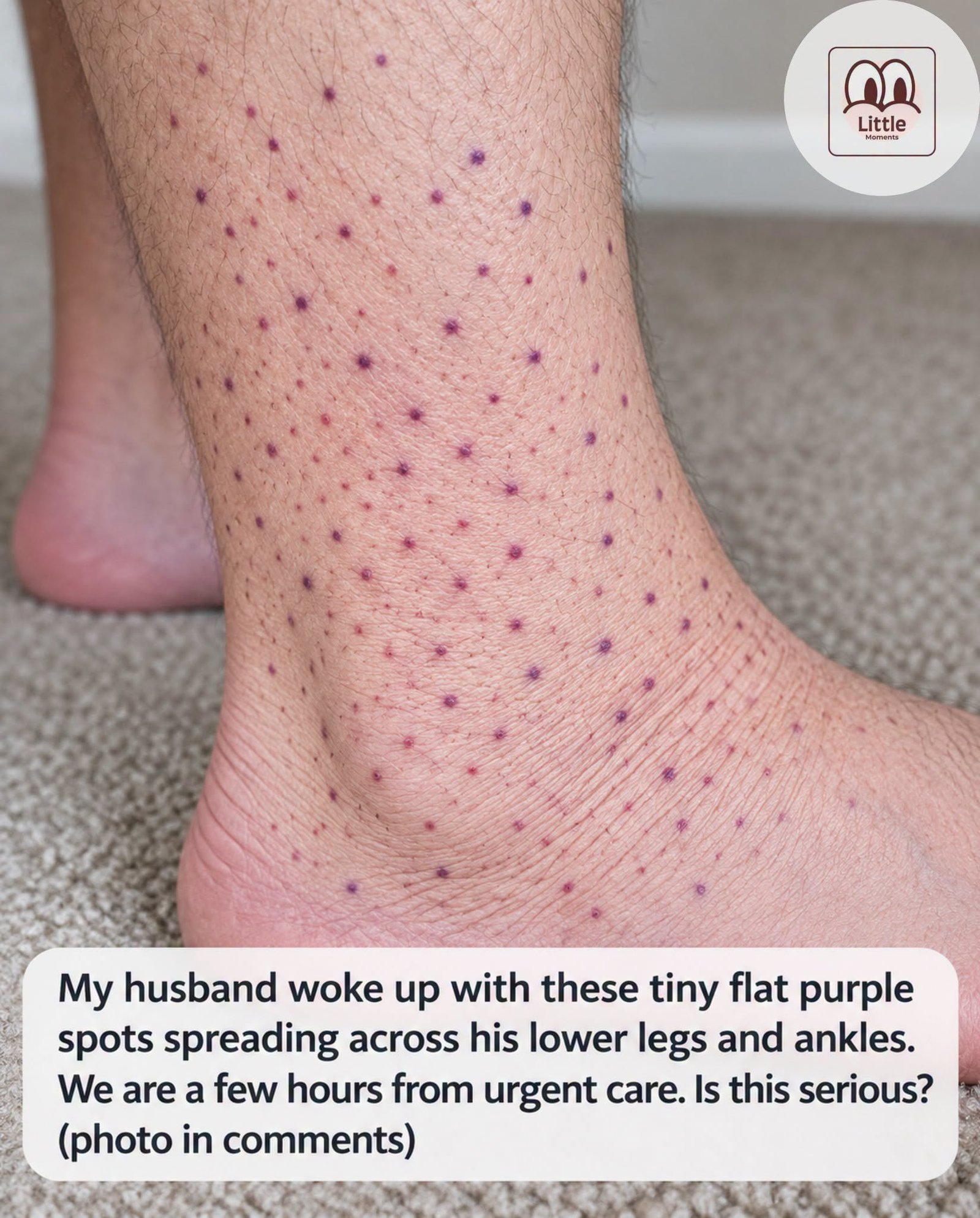
If my husband woke me up to show me tiny, flat purple dots rapidly spreading across his lower legs and ankles, I would absolutely not brush it off as “just a simple rash.” When spots of that nature do not blanch—meaning they do not temporarily fade or turn white when pressed—one highly concerning possibility is petechiae.
Petechiae themselves are not a specific disease; rather, they are a physical symptom of bleeding beneath the skin. While the underlying cause is occasionally minor, it can also be tied to a severe, systemic problem that demands urgent medical attention. When you live hours away from the nearest urgent care center or hospital, the central question immediately shifts from “What soothing cream should I try?” to “How do I decide whether we need to leave right now?”
I am going to walk you through exactly what petechiae look like, the various conditions that can cause them, the critical danger signs that elevate the urgency, and the precise steps you should take in the next 10 to 30 minutes while deciding whether to make that long drive.
I will also share the practical, step-by-step checklist I would utilize in my own home, because when you are panicked and far from professional care, actionable steps are infinitely more helpful than vague reassurance.
1. What Petechiae Usually Look Like
Petechiae are minuscule, pinpoint spots created by tiny amounts of hemorrhage just beneath the skin’s surface. They frequently present in shades of red, purple, or reddish-brown and typically measure about 1 to 2 millimeters in diameter, although tight clusters can make the affected area appear blotchy. The defining characteristic is that they are entirely flat against the skin, unlike raised insect bites or hives.
Another crucial diagnostic clue is that they generally do not turn white when subjected to pressure. A quick, reliable home assessment is the “glass test”: press the side of a clear drinking glass—or simply press your finger firmly—over the spots for 3 to 5 seconds. If the dots remain distinctly visible and purple instead of temporarily fading to the color of the surrounding skin, it strongly points toward petechiae or purpura rather than a standard, inflamed rash.
2. Why the Lower Legs and Ankles Are a Notable Location
The lower legs and ankles are incredibly common areas to first spot petechiae because gravity naturally increases the vascular pressure in the microscopic blood vessels of the lower extremities. This is particularly true after prolonged periods of standing, walking, heavy lifting, or enduring a long car ride. The friction from a tight sock line can also draw a person’s attention to the area when getting dressed in the morning.
However, just because it is a “common place” to notice them does not guarantee they are harmless. If the spots are visibly multiplying, aggressively spreading up the calves, or beginning to appear on entirely different areas of the body, it raises significant medical concern compared to a localized handful near the ankle bone.
3. Common Causes That Are Less Dangerous
There are indeed several relatively benign reasons why petechiae might form. Severe bouts of coughing, repeated vomiting, intense physical straining due to constipation, or lifting exceptionally heavy objects can all cause fragile capillaries to burst. In these specific scenarios, the spots are generally confined to a limited area (like the face, neck, or chest), and the individual otherwise feels perfectly normal.
Intense friction or sustained pressure can also be the culprit. I have seen families panic over a disturbing rash that ultimately turned out to be pressure-related trauma following a grueling hike in tight boots or high-compression socks. Certain everyday medications can also actively contribute to this, including aspirin, ibuprofen, prescribed blood thinners, specific antibiotics, and corticosteroids.
Nevertheless, a brand-new, widespread eruption covering both lower legs is absolutely not something I would ever assume to be minor without proper medical validation.
For Complete Cooking STEPS Please Head On Over To Next Page Or Open button (>)